
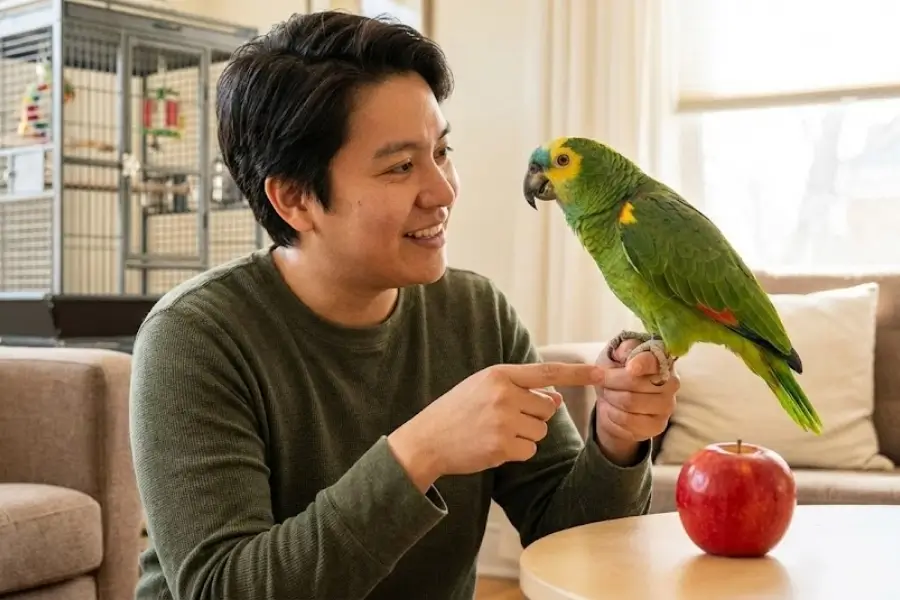
The ability of certain bird species, especially parrots, to mimic human speech is fascinating and rewarding. Teaching your bird to talk is an excellent form of mental stimulation and a powerful way to bond. While every bird is an individual, and some will naturally talk more than others, consistent technique, clear communication, and positive reinforcement are the keys to unlocking their vocal potential.
1. Establishing the Right Learning Environment
Birds are highly observant and learn best when they are focused, relaxed, and not overstimulated.
– Choose the Optimal Time: Birds are often most receptive to learning in the early morning or late afternoon, when they are alert but calm. Avoid training when they are tired or hyperactive.
– Create Focus: Conduct short training sessions in a quiet room, free from distracting background noise like television or competing music. Your voice should be the primary sound source.
– Short and Frequent: Keep training sessions brief (5 to 10 minutes) to hold their attention, but repeat them often throughout the day. Consistency is more effective than long, infrequent sessions.
2. Speaking Clearly and Associating Words with Meaning
Birds learn words best when they are distinctive and paired with context.
– Clarity and Repetition: Speak the word or phrase slowly, clearly, and enthusiastically. Use the exact same tone and cadence every single time you repeat the word.
– Use an “Excited” Tone: Birds are naturally drawn to high-pitched, emotional tones (which is why many birds first learn to mimic women or children). Use a happy, exaggerated voice to say the target word.
– Provide Context: Link the word directly to an action or object. For example, always say “Bye-bye!” the moment you put on your coat and leave the room. Say “Good night!” when you cover the cage. This gives the sound meaning, which aids retention.
– Names and Simple Sounds: Start with simple, two-syllable words or your bird’s name. Focus on sounds your bird already makes, like a playful chirp or a whistle, and pair those with a word to build a bridge.
3. Leveraging Positive Reinforcement
Positive reinforcement is the single most effective method for encouraging vocalization. Never punish a bird for making unwanted sounds or for not talking.
– Reward the Attempt: When your bird attempts to mimic a word, even if it’s just a syllable or the right tone, immediately reward them with their favorite high-value treat, a head scratch, or enthusiastic praise.
– Selective Attention: If your bird makes an unwanted noise (e.g., constant screaming), completely ignore it (do not look, speak, or react). Reward them instantly when they stop or produce a desired sound. This teaches them which vocalizations earn attention.
– Play the Rival: The “Model/Rival” technique is highly effective for some parrots. Two people interact: one person (the “trainer”) says the word to the bird, and the other person (the “rival”) says the word and receives a massive reward. The bird, instinctively wanting the reward/attention, is motivated to outperform the rival.

4. Utilizing Tools for Reinforcement
– Recording Devices: Record your clear voice repeating the target words and play the recording when you are not actively training or are out of the house. This provides constant, clear repetition.
– Mirror/Reflection: Some birds respond well to a mirror, thinking they are interacting with another bird. Use this as an additional tool for solo practice, but monitor them to ensure it doesn’t cause aggression.
Conclusion
Teaching your bird to talk is a marathon, not a sprint. Maintain short, fun, and consistent training sessions, focus on positive rewards, and always provide context for the words you use. With patience, you can help your bird unlock their incredible potential for speech and deepen the bond between you.






0 Comments